

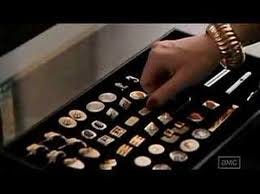
The scene in season 1 of Mad Men when Don Draper goes to Menken’s Department Store to get to know a potential client better, he finds himself and Miss Menken in front of a display case full of cufflinks and tie pins. She selects for him a surprisingly expressive set of medieval knight helmet cufflinks, which haunts him for an episode or two after an awkward encounter on the roof of the store. But what really stuck with me is the selection of cufflinks, tie pins, tie bars, and more was abundant. Even with the social revolutions happening in the 60s, the professional world retained the standards of men’s jewelry from the previous generations. All characters are seen in daily work suits adorned with jeweled tie pins, bars, and cufflinks, things only reserved for formal occasions (or not owned at all) by most today.
While popular culture reserves the majority of fine jewelry for women, modern men are often seen with pendant chains, roped or linked bracelets, oversized rings, or earrings. While we don’t take issue with these kinds of jewelry when worn well, they’re a far departure from what was present in the past. The mass market jewelry for men in the 1930s through 1960s was expressive but understated, refined but restrained. It wasn’t really even thought of as jewelry, as that was a more feminine term. It was part of a professional man’s daily look, not for any occasion but the occasion of daily life. While styles of course changed throughout the years, the base sentiment remained the same.
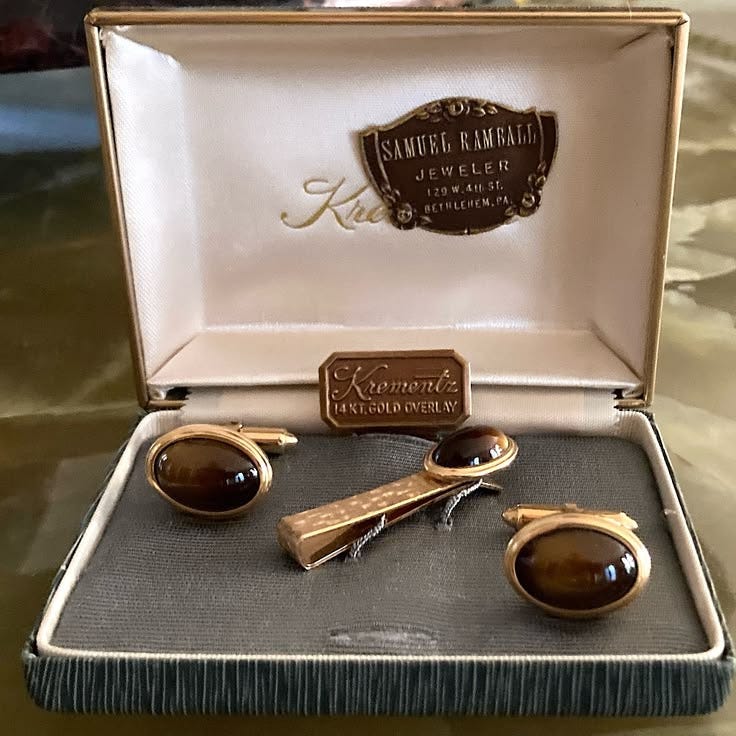
Most men, no matter the decade, often opted for gold as a base metal as it was more harmonious with an array of suit colors. Silver and white gold were reserved for black tie, and most men would have one set in that metal. Many cufflinks were purchased as a part of a set (seen above) which would have included a tie bar in a matching metal and with a matching stone, if applicable. The stud pierced the tie and fastened like a lapel pin, carrying a chain along that fastened through a shirt buttonhole.


Because these pieces were often sold as sets, it always felt coordinated and harmonious. This coordination is fundamentally missing from what we see today; when men wear these vintage-style items today they are often lacking the harmony they would have been in past times. Cufflinks are always matched, but if a tie bar or pin is added, it is often bought separately and doesn’t match the cufflinks. This is the easiest way to elevate the look of jewelry when worn formally. Due to these pieces being mostly worn with tuxedos, it is imperative that shirt studs should match as well (if worn). For us, a tuxedo is not complete without shirt studs. You can find vintage full sets that include studs, cufflinks, and even a tie bar or stud on secondhand platforms and in vintage stores. We recommend checking vintage or antique stores, as these pieces are often neglected and priced lower as the demand is quite low. Some of us at TNBC have found amazing vintage examples for pennies on the dollar of what they’re worth in weight of metal alone!


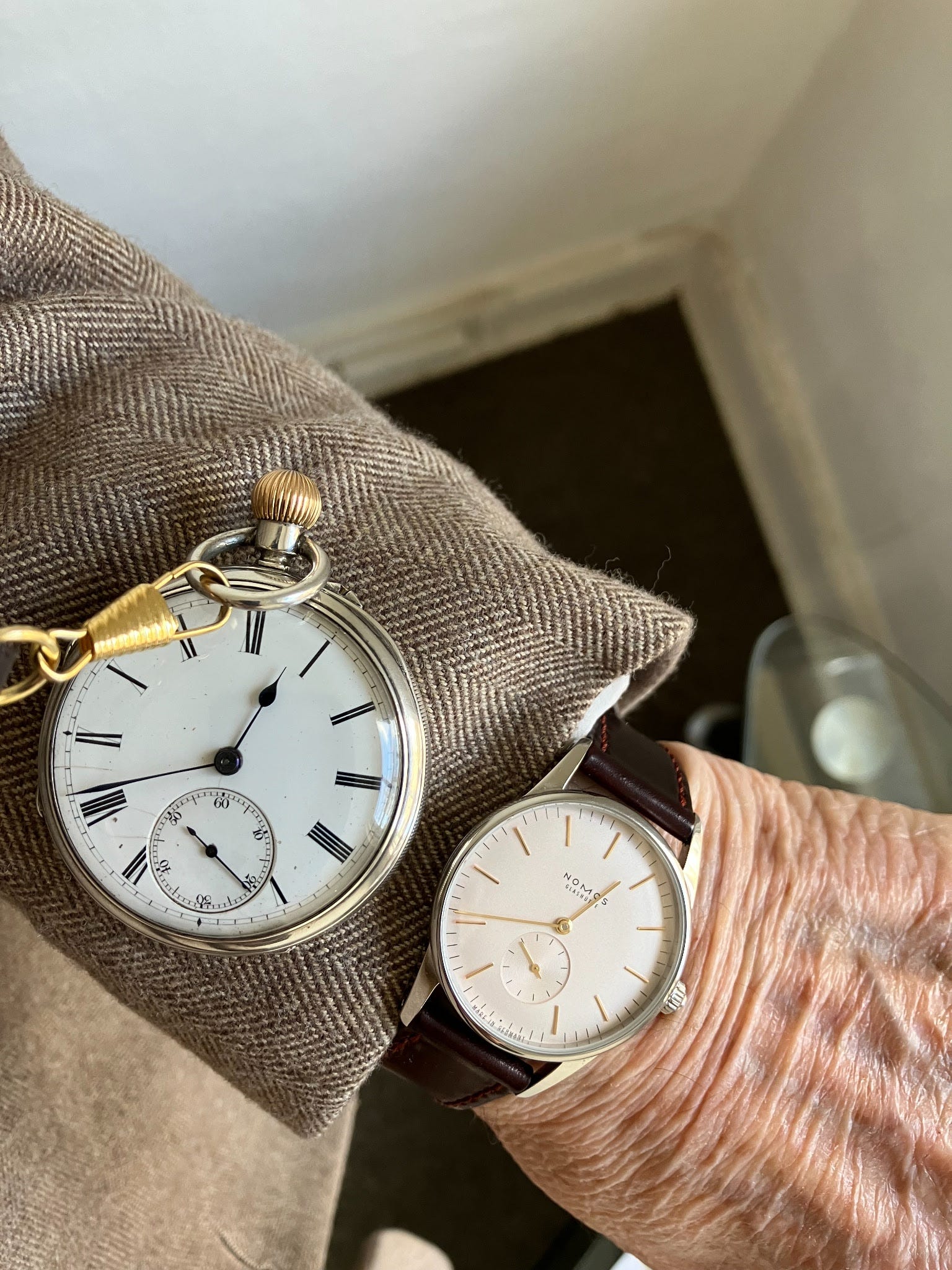
Everything we’ve spoken of thus far is still seen occasionally in modern times, but an underappreciated piece that was a daily carry in the early 20th century was pocket watches. Now regarded as quite costume-y, pocket watches were very common in the 1910s-1950s, before central air conditioning became commonplace and men stopped wearing as many three-piece suits. The chain of a pocket watch seen hanging out of a waistcoat was revived in popular culture recently becoming an identifiable part of Peaky Blinders while the show was airing in the late 2010s. As wristwatches became more popular in the postwar period of the 40s and 50s, many houses that previously made pocket watches converted over to keep up with their clients. We at TNBC believe a classically styled, black strap wristwatch is one of, if not the most, essential accessory a man can have
What you will see on most men today is a wedding ring. Rings are ancestrally important in nearly all cultures, as signifiers of marital or social status, guild affiliation, or familial lineage. Knowing what metal will fit best with your skin tone is an important part of choosing a wedding band, as you’ll be wearing it forever (hopefully). That determination should apply to the metals of your watches and things like cufflinks as well. Lighter, paler complexions are best complemented by white metals, while darker, richer tones are best complemented by yellow or rose gold. Not all rules are meant to be followed to completeness however. Find what works best for you and your lifestyle, and you will never wear any jewelry that doesn’t make sense.
Signet rings are a personal favorite of mine, classically styled in gold with a monogram. There are thousands of images including prominent families like the English Royal Family wearing signet rings that bear their family crest. Most of us, and definitely most Americans, do not have anything like a family crest; a monogram is the next best option, something uniquely yours that still carries your family name. There are fewer and fewer makers in the world that can create a true signet ring for you, one like the below that should be worn on the pinky of your non-dominant hand, along with a wristwatch and wedding band. That can make your non-dominant hand feel a little heavy, especially with nothing on the opposite hand - but the reason it is worn on that hand in the first place is in case you should need to do any physical task using your dominant hand, so that your jewelry is protected.


Wearing jewelry in 2026 is a tough approach. If you’re an enthusiast of classic style like we are, you want to get the foundations right so you stay true to your forefathers. But why should you? The new generation should be free to carve out its own rules and abide by its own aesthetics. What good does appreciation for the past do? (Hint: a lot). The key word is “appreciation” rather than imitation. Knowing the rules of the past can help you break them in tasteful ways today. Maybe your cufflinks have huge expressive stones that match the hues of your tie. Maybe your watch has a mixed metal bracelet (not my favorite but to each their own) and your cufflinks mismatch your tie bar intentionally. As said before, if it is worn authentically, it cannot be wrong. You will notice nearly immediately if this jewelry is worn because the occasion required it or if it is with an appreciation for the pieces themselves.
Note that HRM Charles is wearing his Signet over his wedding ring on his pinky finger. He's well-known for that crotchet.