

The world of luxury watches is strange.
Did you know, for instance, that there is a yearly Oscars-esque award ceremony called the Grand Prix de Horlogerie de Geneve wherein watchmakers win awards in various categories and take home trophies? If you’re a normal person, you did not know this, but if you are a watch enthusiast, you know not only that such a ceremony exists but also who won each category, including the coveted Aiguille D’or Grand Prix — the GPHG’s version of Best Picture.
In 2023, the Aiguille D’or winner was this watch:
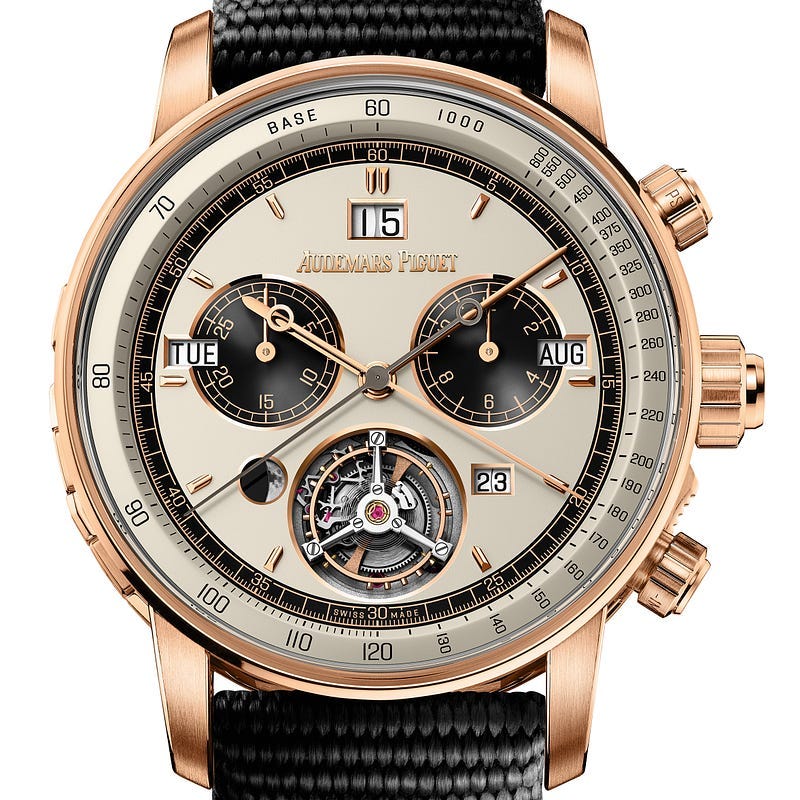
This $1.6 million timepiece is called the Ultra-Complication Universelle RD4. It’s made of pink gold and, with all those subdials, hands, pushers, scales, bells (literally), and whistles (figuratively), appears cluttered yet sophisticated, like the inside of a cockpit. Most of us have no idea what any of the things do but it fills us with inarticulate wonder. “Wow,” one might say, “I have no idea what any of this does but look at it!”
The truth is that the RD4 is impressive. It can do just about everything a mechanical watch can possibly do. It can tell you the time (obviously), the full date (including leap years) until 2100, record elapsed time, read the hours, minutes, and seconds and “repeat” them using a hammer that strikes the case like a gong, chime every hour, and tell you the phase of the Moon. And all this in something that you could, at least in theory, wear on your wrist.
But in order for the RD4 to be interesting at all, you have to do something that watch enthusiasts do regularly but that makes little sense to outsiders: you have to ignore the simple fact that mechanical timekeeping is, unequivocally, unnecessary. The RD4, “ultra complicated” as it is, can’t do 1/1000th of what any smart watch can. In fact, you don’t even have to spend smart watch money to get a watch that is, in some ways, better than the RD4. Walk into any department store with $100 and you can probably find a battery-powered watch that will keep better time than the $1.6 million RD4.
Once you think about this inherent redundancy, the whole idea of having an “Oscars of Watchmaking” feels a bit like having an “Oscars of telegraph-making.” Why are people still making these things? Why are people still buying them? Why are they giving out awards for them?
And I’m not just talking about small-batch, contest-winning mega watches like the RD4. The entire mechanical watch industry, from the $100 Seiko to the $50,000 Patek Philippe, is redundant and has been since the 1980s. It should be dead.
And yet the mechanical watch is anything but dead. Brands like Rolex, A. Lange & Söhne, and Grönefeld command waitlists so long you may as well put your grandchildren’s names down. But it’s not just the market that is flourishing. There exists now entire internet spaces dedicated to watches: Reddit’s r/watches has 2 million subscribers, YouTube has various channels consisting of disembodied hands holding watches under a macro lens that collect views in the millions, and cults of personality have arisen around watch experts like Tim Mosso and Federico Iossa.
So what gives? Is it just rampant, unfettered consumerism, avarice, and pretension that drives these markets? No. At least that isn’t the whole story.
A Crisis In Quartz
A lot of industries have their own A.D. & B.C., that point when some innovation or other caused a fundamental change to a product or service. There are loads of easy examples of innovations revolutionizing or erasing whole industries: think of what streaming did to video rentals, what ride sharing did to taxis, what Amazon did to shopping, what cassettes did to vinyl records, what CDs did to cassettes, and what MP3s did to CDs.
Watchmaking, too, had its own paradigm shift in the 70s and 80s — one that should have killed the mechanical watch for good but didn’t.
That innovation was quartz, and it started when Seiko, a Japanese company, unveiled the Astron. The Astron was special because it told time in a different way than every other watch up to that point. Instead of harnessing the potential energy of a wound-up spring to keep track of time as it had been done for centuries , the Astron instead utilized the power of a small battery to electrify a quartz crystal.
Because quartz oscillates at a predictable and stable rate when a current passes through it, measuring a second is a matter of counting 32,768 vibrations. This, it turns out, is significantly more accurate than purely mechanical timekeeping, which must wage constant battle against the forces of friction, ambient temperature, and material fatigue.
Quartz watches like the Astron represented the biggest leap in hundreds of years in timekeeping accuracy. Before the Astron, watches would be rated on how many seconds per day they lost; after the Astron, watches came to be measured in seconds per month, or even year.
These days, the industry timeline is split into two: Pre Quartz and Post Quartz. But it’s not just accuracy that drove this division. The real reason the Quartz Revolution (or the Quartz Crisis) is the modern delineation point in watchmaking has less to do with accuracy and more to do with manufacturing. Now, the Astron was initially not inexpensive, but it was a key step in bringing watch manufacturing into the modern age.
For centuries, Switzerland built its reputation as a watchmaking powerhouse around a vision of the capital-C Craftsman. Quartz technology, however, was watchmaking re-imagined, not in the image of generational craftsmen toiling in smoky snowed-in Swiss cottages, but in automated assembly in futuristic factories. As Japan , with companies like Citizen, Casio, and Seiko embraced the cutting edge of modern streamlined manufacturing, prices on these highly vertically integrated timepieces inevitably fell. This left the Old Guard Swiss manufacturers trying to sell a worse product at a higher price — a feat of economic acrobatics companies like Patek Philippe, Audemars Piguet, and Vacheron Constantin (known as the Holy Trinity of watchmaking) actually managed to pull off. Eventually, that is.
The thing about the watches the Holy Trinity were trying to sell is that they were only worse products if you consider them practically, that is, in their ability to tell time. Of course this seems completely natural: timekeeping is exactly how most people would in fact judge a wristwatch. But this is not at all how watch enthusiasts, who are not regular people, think. This means that, instead of relying solely on mechanical precision to sell watches, watchmakers started finding other selling points in their watches.
Of course, all watches must tell time (unless it’s one of these apparently). Once when discussing the minimal story in his action-focused Doom video game franchise, video game developer John Carmack said, “Story in a game is like a story in a porn movie. It’s expected to be there, but it’s not that important.” The same is true with watches and time. You can’t really sell a watch that doesn’t tell time, but somehow the time is actually secondary , or perhaps tertiary to what watch lovers are actually seeking.
What watch enthusiasts were seeking ( or what marketing departments and PR firms convinced them they were seeking ) could not be delivered through the Quartz Revolution. What quartz had that made it mass marketable was mass producibility, accuracy, and affordability ; it also highlighted what was so alluring about old-fashioned wristwatches, namely their longevity, artistry, and narratives they told. That is to say that if a watch promises to become an heirloom, or is painstakingly handcrafted, or is an historically interesting model (or, hopefully, all three ) watch companies have figured out it doesn’t matter if a given watch is the most practical or accurate way of telling the time.
The Holy Trinity, and companies like them, survived, and currently thrive, by acknowledging that their products appeal not to their customers’ sense of practicality, but to their senses of artisanship, of tradition, and of manufacture.
Luxury watchmakers, at least the great ones, have a way of making this old-fashioned artisanship tangible and visible, and their customers are willing to fork over serious cash to experience it. Yet, I don’t think it’s fair to write the watch enthusiast world off as simple rampant, soulless, object worship. Even if that is some of the story, there is the impossible-to-ignore fact that some mechanical timepieces are manifestations of thousands of hours of training, painstaking assembly, and months of testing.
The Watch as Kinetic Art
So here’s what the mechanical watchmakers of old were up against. Not only did quartz technology offer a more accurate way of telling time, it did so at a much lower cost. What the manufacturers did was simple: they stopped selling timepieces and started selling art.
Thinking about luxury watches as art is the best way to understand both the market and the subculture that has evolved around the market, and the best way to understand how a watch can be art is to, well, look at one.
Most people think of a watch as being its dial. That is, they ignore what makes the dial function. All it usually takes to capture a layman’s attention is to turn a high-end watch around and show them, through the clear caseback, the inner workings of a proper mechanical wristwatch.
When you peer into the inside of a spring-powered watch, and see all the ticking and spinning and clicking, something that should have been incredibly obvious becomes instantly clear: these are little machines. Generally, you can see the balance ticking away, oscillating back and forth so fast it looks like it’s spinning. You can see the pallet fork gracefully deal with being smashed into by the balance. You can see the subtle forces of the escapement being reduced by gear trains to, through engineering genius, spin accurate second, minute, and hour hands — all powered by a tense piece of metal. This feeling of awe is heightened the older a watch is: imagine an endlessly running, high-tolerance tool like a watch ticking on and on for decades.
In these ways, each watch is more like a little kinetic sculpture than a practical time-telling tool. And this is where the magic lies: the magic not of electrons and capacitors, but of intricate pieces of metal interacting with one another flawlessly and precisely. Yes, a watch is anachronistic, but enthusiasts will tell you that in this virtual, digital, disposable world, that’s not bad — it’s actually the whole point.
Watches are about the limits of what humans can do in a workshop, not the limits of micro-transistors in laboratories.
Constraining Innovation
So what we have today is a collection of companies not selling simple timepieces, but small works of mechanical art that hark to a bygone era. But watch companies must compete and, somehow, they must innovate. Some watchmakers compete in the realm of finishing. In the watch world, finishing includes things like beveling levers on the inside of the watch, applying engine turning to bridges, or black polishing various facets on the front and back of a watch.
But other companies, like Richard Mille, De Bethune, and Ulysse Nardin, have made a name for themselves through consistently innovating in the technological aspects of their watches. But their innovations are all inherently constrained because, in the battle to sell that aforementioned mechanical magic, watchmakers learned the hard way that quartz is no ally. So, if you want to be considered “haute” in the horology world, you are allowed to pursue better and better timekeeping methods so long as you never put a battery in your watch.
This means, essentially, that watchmakers are solving problems that don’t exist, or they exist in the same way problems like scan lines on CRT televisions exist — they are there but they bother precisely zero people. De Bethune, for instance, holds a dozen or so patents on various watch movement components, each designed to ever incrementally increase accuracy and resilience.
And, make no mistake, from an engineering standpoint the machines made over at De Bethune are interesting and impressive, but no amount of mechanical accuracy improvement is ever going to change the fact that you can buy a watch (for a couple hundred dollars mind you) that gets its time by syncing with an atomic clock accurate to +/- one second every 300 million years. In the arena of timekeeping, mechanical watches aren’t even in the running.
To use an analogy, imagine if RCA or some other oldish electronics company, opened up a boutique on a fancy high street that sold high-end, hand-made, VCRs. Here, salesmen in European-cut suits and loafers might tell you about titanium capstans, silicone pinch rollers, and anti-magnetic drums. You might hear about how recent innovations in direct current have allowed the tapes to rewind at breakneck speeds, or how palladium is now being used in eraser heads to extend the life of the tape, or how recent advancements in cartridge production have allowed for eight-head VHS playback, greatly increasing quality while reducing wear and tear. Imagine these VCRs, which output a worse and lower definition image than something from Fisher-Price, selling for tens, or even hundreds , of thousands of dollars.
Put this way, the whole idea sounds insane, but, it’s basically the business model behind some of watchmaking’s biggest brands: using modern technology to improve upon, what is essentially, ancient technology.
Perhaps no brand illustrates the modern, oxymoronic ethos behind today’s watch industry than Richard Mille. In 2019 Odell Beckham Jr., a wide receiver playing for the Cleveland Browns, made headlines because he wore a very expensive watch during a game against the Tennessee Titans.
This act made headlines, but most outlets discussed only the watch’s price tag (about $190,000 new at the time) rather than the incredible feat of engineering his Richard Mille RM 11–03 actually is. As hinted at earlier, a mechanical watch is a rather finicky item. What makes them work well — namely, micro precision — also makes them quite delicate and sensitive. Advances have been made in watch design in recent years — notably by Richard Mille and Rolex — to make them more durable, but, still, counting a second using only springs and gears is rather precise work which is easily interrupted by shock. Beckham, with almost alarming nonchalance, played a full-contact sport wearing his mechanical timepiece.
The marketing team over at RM was likely floored by Beckham’s stunt because Beckham at the time was not an ambassador or sponsee of the brand. He was just a customer. But as flabbergasted as the RM marketing team probably felt that day, it’s safe to say the engineers at RM were ecstatic. A full game of American football is exactly the kind of thing Richard Mille designs their watches to do: it’s what the company wants to be known for.
A hidden layer to the Odell Beckham story, though, takes us back again to a hallmark of the watch industry: constrained innovation. Beckham’s RM 11–03 carries a six-figure price tag. Sure it’s made out of space-age lightweight materials like silicon and carbon fiber and is shock resistant, but if Odell, for whatever reason, really needed to tell the time on the football field, he could have purchased a Casio G-Shock, a watch designed and constructed entirely around the idea of shock resistance and durability, for around $75. Plus, the Casio tells better time. But that’s not what Odell and enthusiasts like him want. They want a mechanical watch that can do these things.
There was of course a time where research and innovation in mechanical watchmaking actually made sense. There is perhaps no single innovator in watchmaking more central than Abraham Louis Breguet. Breguet’s accomplishments are Newtonian in scope. If there is a component in a watch he didn’t invent, he most certainly improved upon it in some way. The most exciting of these inventions was designed in the early 19th century by Breguet to combat a problem specific to pocket watches. A pocket watch, by its nature, spends a lot of time in the same orientation relative to gravity as it sits in a pocket. This caused uneven wear on the watch’s escapement. Breguet fixed this by inventing a device he called a tourbillon. This ingenious device rotates the entire escapement so as to wear it evenly.
The tourbillon is redundant in a wristwatch, whose position relative to gravity is ever-changing, but redundancy has of course not stopped high-end brands from including tourbillions in their finest watches. The tourbillon these days is a modern artistic and engineering extravagance that is maybe a good symbol for the entire luxury watch space. Through a little window on the dial you can see an impossibly little, awe-inspiring machine— that was painstakingly planned, designed, crafted, and decorated spin around doing absolutely nothing useful at all.
But it isn’t just mechanical complexity that gets people to wait on 10-year-long waiting lists. The other draw is, of course, narrative.
The Watch as a Narrative Vehicle
The art of watches, to a lot of people, extends beyond their mechanisms and into the realm of narrative.
In 1970, Apollo 13 was in trouble and it needed to get home with limited resources. During the scramble to get the spacecraft habitable for an emergency return journey to Earth, Apollo 13 had veered off course. Due to electrical problems, the digital timers on the ship were unusable. So, NASA astronaut Jack Swigert turned to his wrist. He flawlessly timed a fourteen-second burn using his Omega Speedmaster.
Four years earlier, Neil Armstrong was the first human to step foot on the moon. He had a Speedmaster on his wrist.
Four years before that, Wally Shirra orbited the Earth as part of the Sigma 7 mission. You know which watch he had on his wrist.
NASA still issues the Speedmaster to astronauts, and you can still purchase one from Omega. Now, the watch itself is beautiful and well-crafted, but aesthetics alone do not sell Speedmasters. What does sell these watches is the stories and history attached to them. If you’ve got the money you can wear a watch that is—to anybody except an expert—identical to the first watch worn on the Moon. Make no mistake, Omega is absolutely aware of this. This is why they sell countless variants of the Speedmaster, the most notable of which comes with a Velcro strap long enough to fit around the cuff of a spacesuit. Seriously.
The Speedmaster story isn’t unique, though. Where Omega sells space, Rolex sells ocean. In 1927, Mercedes Gleitze swam the English Channel with a Rolex around her neck. This watch became the first to cross the channel, submerged, and come out in France ticking. Rolex then kept improving on the design of their watches, eventually releasing the first watch waterproof to 100 meters. The Submariner, as it was called, became the dive watch standard. James Bond wore one, as did just about any professional diver whose name you know. Today, Rolex actually sells a watch that is water resistant to a depth actually deeper than the ocean gets on Earth.
But Rolex and Omega aren’t the only companies selling history. JLC sells a watch that was invented, allegedly, to be worn during polo matches; Vulcain sells a watch with an alarm that was worn by several presidents; Cartier will sell you the first purpose-designed pilot’s watch (made initially for a dirigible); Tag Heuer still offers the watch Steve McQueen wore in Le Mans; Hamilton sells the watch Will Smith wore in Men in Black; and on and on and on.
From a marketing perspective, these narratives are what the modern luxury watch business thrives on. If watch companies can’t sell true innovation, they can, at least, sell you their history of innovation. And if they can’t do that, they can at least sell you their history of being wrist decorations for famous people.
Buy It For Lives
There’s no denying that any non-essential good that costs hundred or thousands of dollars is inherently a status symbol. But it would also be disingenuous to think of the entire luxury watch space as repulsive materialism any more than we think of art itself as materialistic.
Maybe the last thing to consider when debating the value proposition of purchasing a device to tell time that costs 5 times what the best iPhone costs is longevity. In an era where we accept planned obsolescence as fact, where it’s cheaper to buy a new refrigerator than to fix your old one, where a phone battery lasts only for the two years it takes to pay it off. There is something special about owning a device that can be endlessly maintained.
This idea of endless maintainability is actually the cornerstone of many definitions of “luxury” in the watch world: and it’s a good one. Think about all the things you own. How many of them will still be useful in 10 years? 30 years? 100 years? Your books will yellow and brittle, your television will die, your car will weather, your couch will moulder, even your coffin will melt away. Your watch however, will keep on ticking.
That’s gotta be worth something.
C.R. Burgess is a writer and stay-at-home dad based in northern Scotland. When he isn’t chasing around an unruly 2.5 year-old toddler, he’s over-contemplating parenting on Substack.
Great read, thank you. I like Elliot Brown watches and they are in no way expensive and marry mechanical style with quartz. I don’t agree with the smart watch element of the article; they are data harvesting/surveillance devices for big tech and governments, not watches.